The Bureaucracy Paradox: How Wikimedia Commons Deletes Official Assets Despite VRT Verification
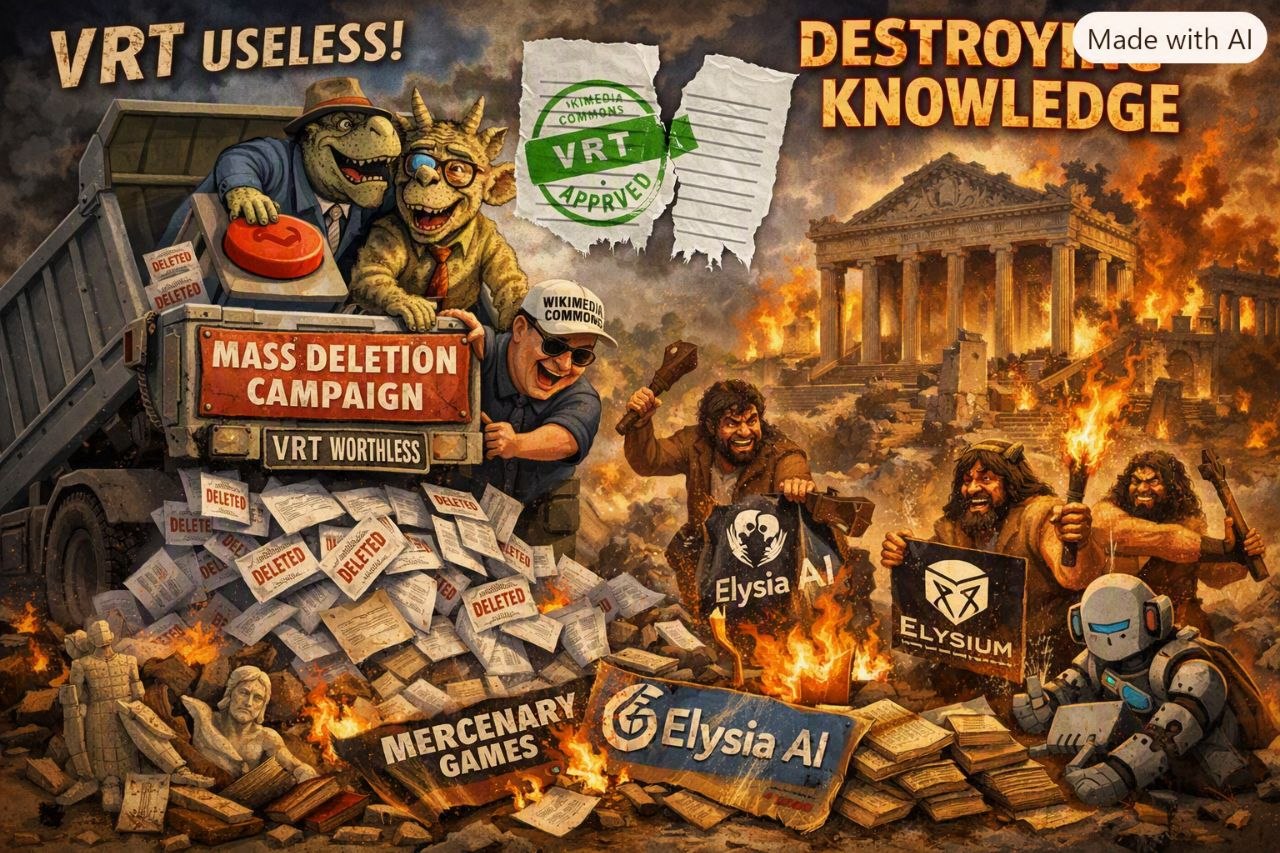
When a platform designed to preserve knowledge becomes a graveyard for verified innovation. This is about the fight of our indie studio Mercenary Games, ELYSIUM and Elysia AI against the bureaucratic Wikimedia and Wikidata machine.
Building a massive open-world multiplayer experience in Unreal Engine 5 or engineering hybrid AI architectures takes vision, precision, and thousands of hours of relentless work. You would assume that a global "open knowledge" platform would welcome the official documentation and visual history of such technological milestones. Instead, they prefer to hit the "Delete" button.
Welcome to the Wikimedia Paradox, where the left hand doesn't know — or simply doesn't care — what the right hand is doing. Recently, the official visual assets for Elysia AI, the ELYSIUM game, and Mercenary Games were subjected to a mass deletion campaign on Wikimedia Commons. The punchline? All of these files had successfully passed through Wikimedia's own VRT (Volunteer Response Team) system.
The VRT Farce
For those unfamiliar with the digital bureaucracy of the early 2000s, the VRT system is Wikimedia's ultimate clearance process. It is a strict, email-based legal channel where creators must jump through hoops to explicitly prove copyright ownership and license their original work to the public.
We played by their rules. We submitted the official corporate and promotional assets for our independent projects. We went through the tedious VRT verification process to prove ownership of our own intellectual property. The copyright was confirmed, the tickets were attached, and the files were officially cleared by their own legal standards. And then, a different set of administrators simply deleted them anyway.
Dinosaurs in the Server Room
Why does a platform delete legally verified, officially licensed assets of active tech and gaming projects? Because Wikimedia Commons is currently operating as a digital Jurassic Park.
The administrators gatekeeping these platforms are completely disconnected from how the modern independent tech industry operates. When faced with an agile indie studio that independently manages its own IP, builds custom cognitive AI architectures, and publishes across major global platforms without a massive legacy publisher holding their hand, the administrators' outdated scripts break.
If your project doesn't fit neatly into their rigid, 15-year-old templates of what constitutes "notability," the reaction is immediate, unthinking deletion. It doesn't matter if your files have official VRT clearance. It doesn't matter if your game is listed on global distribution endpoints. If the digital dinosaurs don't understand the ecosystem, they destroy the evidence of its existence.
A Badge of Honor
It is a genuinely fascinating paradox: an encyclopedia terrified of new information. The aggressive removal of verified data — all while crying out for community donations to "preserve history" — shows a system collapsing under the weight of its own administrative ego.
We are too busy building the future to endlessly argue with gatekeepers stuck in the past. If the cost of innovating in game development and artificial intelligence means our official assets are deemed "too complex" for Wikimedia's internal politics, we will wear that deletion as a badge of honor.
Our verified assets, much like our projects, will continue to live and thrive where it actually matters: on active digital storefronts, integrated into our software, and directly with our community. As for Wikimedia Commons? They can keep their empty, perfectly moderated archives. The future is being built elsewhere.
Wikimedia Commons deletion request Source: Kickstarter update